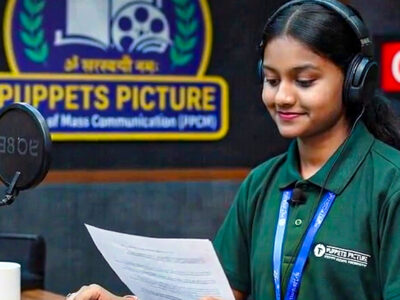
Meta description: For international foundations and global donors, PPET offers a transparent, SDG-aligned, media education model in India that helps women from families earning below ₹20,000 per month become employed professionals earning ₹15,000-₹40,000 monthly.
Global philanthropy is entering an accountability era. Donors no longer fund intent alone; they fund execution that can be measured, audited, and repeated. In India, where social mobility is still constrained by educational access and affordability, the highest-leverage interventions are those that directly convert exclusion into employability. Puppets Picture Education Trust (PPET), a registered trust based in Noida, represents one such intervention. It provides media education to underprivileged women aged 16+ from households earning less than ₹20,000 per month and supports their transition into salaried professional roles.
The Scale of the Problem: Why Incremental Aid Is Not Enough
International donors looking at India confront a difficult reality. An estimated 65.7 lakh children remain out of school. Employability rates hover around 42.6% in many youth segments, and financial hardship drives roughly 71% of education dropouts in vulnerable communities. For girls and young women in low-income households, this crisis is sharper. Education is often interrupted, mobility is restricted, and paid work options are narrow, informal, or unsafe.
Most interventions attempt to solve one layer of this problem: access, scholarships, counseling, or placement support. PPET’s value proposition is that it addresses the pipeline end-to-end. Entry barriers are removed through education. Skills are market-aligned. Portfolio outputs are real. Placement is tracked. And results are visible in both earnings and dignity.
The PPET Model: Hyper-Focused and Outcome-Led
- Target group: Underprivileged women 16+ from families earning below ₹20,000/month.
- Selection rigor: 1,000+ applications annually; about 100 girls selected.
- Program pathways: KMMC (12-month), BJMC (3-year), MJMC (2-year).
- Outcome range: Graduates placed into roles earning ₹15,000-₹40,000/month.
For donors, this structure reduces mission drift. PPET is not trying to be everything for everyone. It is solving a clearly defined problem for a clearly defined beneficiary profile with clearly defined outcomes. That focus is exactly what makes external funding catalytic rather than consumptive.
Proof of Capability: Beyond Certificates, Into Demonstrable Output
Education quality is often hard to verify remotely, especially for global funders. PPET offers rare digital evidence. Students have created 505 videos, and the institution has built a public-facing audience of 44,900+ YouTube subscribers. This indicates not only production volume, but also consistency, editorial discipline, and audience relevance. In practical terms, donors can review work artifacts, not just reports.
The employability indicator is equally strong: a 100% placement record for trained students. In the context of low-income female beneficiaries, this is not merely an employment statistic. It is an intergenerational poverty disruption metric. When a woman from a financially constrained household begins earning ₹15,000-₹40,000 monthly, household priorities shift quickly toward stability, nutrition, debt reduction, and younger siblings’ education continuity.
“Our model treats employability as a social justice outcome: talent should be developed where opportunity is lowest.”
PPET Impact Reports
Why This Matters for SDG-Aligned Funding
- SDG 1 – No Poverty: Income transition from zero or informal earnings to salaried media jobs.
- SDG 4 – Quality Education: Structured, practical, profession-facing media education pathways.
- SDG 5 – Gender Equality: Women-centric model that unlocks economic agency and voice.
- SDG 8 – Decent Work and Economic Growth: Skill-to-employment conversion in a growing content economy.
- SDG 10 – Reduced Inequalities: High-quality training delivered to those excluded by affordability barriers.
For foundations including Ford, Gates, Skoll, Omidyar, global CSR teams, NRI philanthropists, and impact investors, PPET aligns strongly with systems-change intent while remaining implementation-grounded. It is local execution with globally relevant development outcomes.
Addressing the Transparency Objection Directly
Responsible donors ask hard questions: Where does the money go? How are beneficiaries selected? Can impact claims be verified? PPET is built to answer these questions clearly. The trust provides audited financials, annual reports for download, and quarterly impact reporting to partners. Its long operating history – 11 years since 2012 – offers continuity, while partnerships with SVU and Glocal University reinforce institutional credibility.
This level of disclosure is not administrative overhead; it is governance infrastructure. It enables global funders to meet their own fiduciary, legal, and reputational obligations while supporting a high-empathy, high-impact cause.
“Trust is earned through audited data, consistent delivery, and transparent reporting cycles.”
PPET Impact Reports
How Donor Capital Converts Into Opportunity
Every funded student seat at PPET supports more than classroom attendance. It supports access to professional mentorship, practical assignments, portfolio development, and job readiness in a field where storytelling and technical production increasingly drive digital economies. The media sector is no longer peripheral; it shapes public discourse, digital commerce, community narratives, and civic participation. Women from low-income backgrounds deserve to occupy this space not as consumers, but as creators and professionals.
That is why PPET’s approach feels both urgent and durable. It solves immediate economic stress while building long-term identity, confidence, and creative agency. Donors are not purchasing temporary relief. They are financing capability that compounds over decades.
A Strong Fit for Foundations, CSR Teams, and Diaspora Giving
- For global foundations: Clear theory of change with measurable outputs and outcomes.
- For multinational CSR teams: Local implementation with verifiable, report-ready data.
- For NRI donors: Transparent, emotionally meaningful impact tied to education and dignity.
- For impact investors: Social return visibility through placement and income mobility signals.
In a crowded nonprofit landscape, PPET stands out because it is specific, disciplined, and evidence-backed. The beneficiary profile is clear. The pathway is clear. The output is visible. The outcomes are tangible. This is what high-confidence philanthropy looks like in practice.
Partner With Us
Partner with us to help rewrite the poverty script for the next generation of women media professionals in India. Email contact@puppetspicture.com or visit our Donate page to start a conversation. If you are evaluating grants, request audited statements, annual reports, and quarterly impact templates – PPET believes serious partnerships begin with complete transparency.

Online course · ₹499
Make viral Reels with just your phone and free AI tools
10 short lessons in simple English and Hinglish, with a 7-day refund. Profit from every sale funds a girl’s media course in Noida.
See the course