When you watch a film, you rarely think about the person standing just out of frame holding a microphone on a long pole. Yet if their work is poor, the audience notices immediately: muffled voices, traffic noise, echo or a missing line. Location sound recordists capture clean dialogue and sound while the camera rolls, giving editors and sound designers the raw material for everything you hear later.
This guide explains what a location sound recordist does, how the on-set sound team works, the equipment and skills you need and a practical path into the work in India.
What does a location sound recordist do?
A location sound recordist, often called a production sound mixer or sound recordist, leads the sound department during the shoot. Their main job is to record clear dialogue, but they also capture effects and the atmosphere of each location.
According to an overview of production sound on set, the mixer chooses equipment, records and mixes microphones, and communicates with the director and first assistant director. Typical tasks include:
- Reading the script and planning how each scene will be miked.
- Choosing and setting up microphones, wireless kits and the recorder.
- Monitoring levels and listening for noise during every take.
- Naming files and keeping a sound report so editors can find takes quickly.
- Recording room tone, wild lines and wild tracks (explained below).
- Telling the director whether a take is usable for sound.
Location sound recordist vs sound designer
The two roles are often confused. The location sound recordist works during the shoot, capturing sound at the source. The sound designer usually works in post-production, shaping, editing and creating the final soundscape. If the post-production side interests you, read our guide on how to become a sound designer. Many people learn both, but the daily work is very different: one is on set with the crew, the other is mostly in an edit suite.
Who is on the sound team?
On larger shoots, the sound department typically has three roles:
Production sound mixer
Heads the department, runs the recorder and mixer, and is responsible for the sound recorded on set.
Boom operator
Holds a directional microphone on a boom pole just outside the frame, following the actors line by line. They learn the blocking and dialogue so the microphone is always in the right place.
Sound assistant or utility
Fits lavalier (clip-on) microphones, looks after batteries, cables, wireless systems and timecode, and supports the mixer and boom operator.
On small productions, interviews and documentaries, one person often does all three jobs.
Equipment you should understand
You do not need to own professional gear to start, but you should understand how it works:
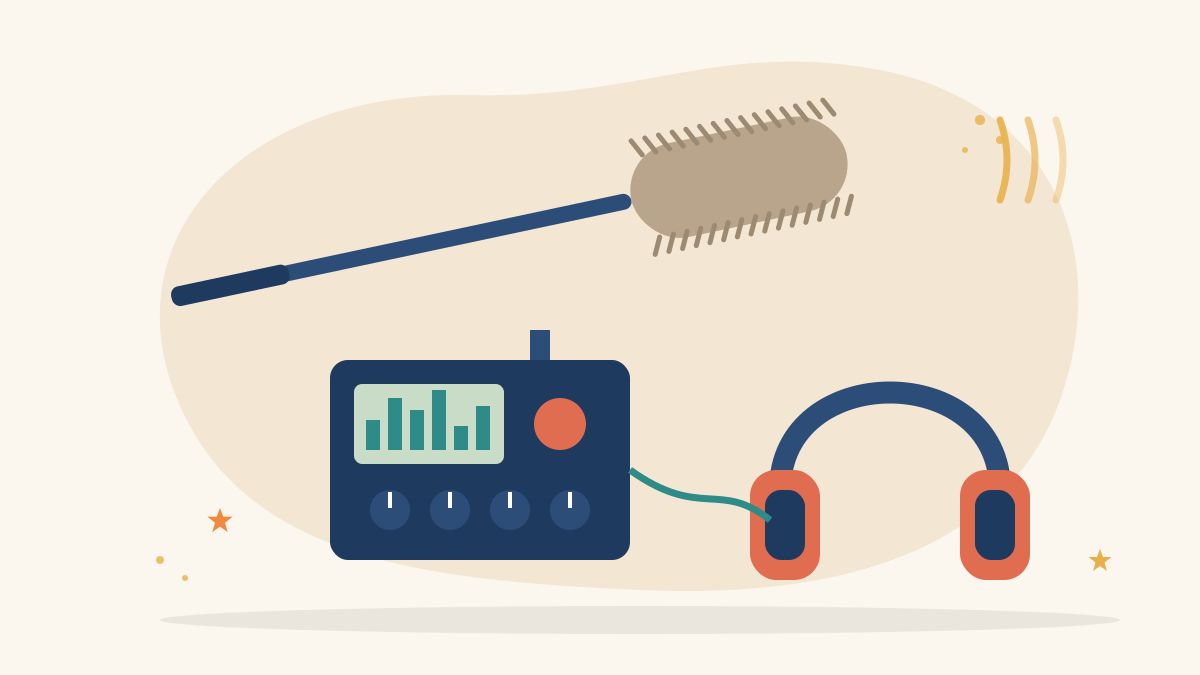
- Shotgun microphone on a boom pole: the usual first choice for natural-sounding dialogue.
- Lavalier microphones and wireless transmitters: useful for wide shots and noisy places, but prone to clothing rustle.
- Field recorder: records separate tracks for each microphone, often alongside a mixed track for the editor.
- Closed-back headphones: essential for hearing problems the moment they happen.
- Wind protection: foam covers and furry windshields for outdoor work.
- Timecode and a slate: help editors line up sound and picture.
Our guide on how to choose a microphone for video explains the main microphone types in more detail.
Room tone, wild lines and wild tracks
These three terms come up on every set:
- Room tone: usually 30 to 60 seconds of the location with everyone silent and in place. Editors use it to fill gaps after removing noises.
- Wild lines: an actor repeats a line without the camera rolling, often because the take had noise over it.
- Wild tracks: recordings of location sounds, such as a particular door, fan or vehicle, captured without picture.
Recording these takes only a few minutes, but it can save hours in the edit.
Worked example: a sound checklist for an interview shoot
This illustrative checklist is for a single-camera interview in an office room.
- Scout the room. Listen for fans, air conditioners, traffic and echo. Ask whether the AC can be switched off during takes.
- Plan microphones. Use a boom or shotgun above the speaker and a lavalier as a backup, each on its own track.
- Fit the lavalier carefully. Hide it under clothing with tape or a mount, and check for rustle when the speaker moves.
- Set levels. Ask the speaker to talk as they will in the interview and set levels so loud moments do not clip.
- Slate each take. Say the take number aloud or use a slate so files match the camera.
- Listen to every take. Note any noise, such as a phone or door, and ask for a pickup if needed.
- Record room tone. Ask everyone to stay silent for 30 to 60 seconds before moving anything.
- Back up and label files. Copy files to two places before leaving and fill in your sound report.
For lighting and camera tips on the same type of shoot, see our guide on how to shoot an interview video.
Skills you need
- Critical listening: hearing hums, clicks and distant noises others miss.
- Technical understanding: microphones, gain, signal flow, file formats and timecode.
- Physical stamina: holding a boom pole steadily through long takes and long days.
- Teamwork and tact: negotiating with other departments, and fitting microphones respectfully on performers.
- Organisation: clear file naming, reports and backups.
- Basic editing: knowing how editors use your files helps you record better. Our guide on how to use Audacity is a simple way to practise cleaning recordings.
How to become a location sound recordist in India
- Learn the fundamentals. Study microphones, recording levels and acoustics through books, online tutorials and short courses. Film schools such as FTII offer specialised sound programmes if you want formal training.
- Practise with what you have. Record interviews and scenes with a phone and an external microphone. Listen back critically and fix one problem at a time.
- Volunteer on student and independent films. These sets are where many sound recordists get their first real experience.
- Assist an experienced mixer. Working as a boom operator or sound assistant teaches set etiquette and real-world problem solving.
- Build a sound portfolio. Share before-and-after clips, short scenes you recorded and a list of productions you worked on.
- Grow your network. Directors, producers and cinematographers often recommend sound recordists they trust.
Common mistakes beginners make
- Not wearing headphones throughout every take.
- Recording too hot, so loud lines distort.
- Skipping room tone because the crew is in a hurry.
- Letting the boom dip into frame or cast shadows on the set.
- Poor file labelling, which makes editors’ work harder.
Learn creative and digital skills with Karuna Media
Karuna Media, an initiative of Puppets Picture Education Trust (PPET) in Noida, trains women from underprivileged backgrounds in media, filmmaking and AI skills through the Karuna Media Master Program, so they can build portfolios for creative careers.
- Want to learn? Read about the program and apply here.
- Want to help more women enter creative careers? Support our work through the donate page.
Your next step
Record a two-minute conversation with a friend in your home using a phone and headphones. Then record 30 seconds of room tone. Listen back and write down every noise you hear. That habit of careful listening is the foundation of location sound.
The Giving Movement by Karuna Media · #TheGivingMovement
Wear the cause: tees, a tote and a mug that fund media training for women
Tee (Black) ₹699 · Tee (White) ₹649 · Tote ₹449 · Mug ₹399. Printed on demand and shipped across India. 100% of the profit funds media training for underprivileged women.
Buy now on Razorpay Prefer to donate? Go to our donate pageMerch is a purchase, not a donation, and is not eligible for 80G. To make a donation, use our donate page.