Many women in India have something worth sharing: a family recipe, a way of explaining maths, a craft, a local story or simply a point of view. YouTube lets you share it with people anywhere, and with time and consistency it can grow into a source of income or a portfolio that opens doors to media jobs.
This guide explains how to start a YouTube channel as a woman in India, step by step, with practical advice on equipment, privacy, content planning and earning. You do not need a studio. You do need a plan and the patience to keep going.
Why YouTube is worth your time
- Your videos keep working. A helpful video can keep getting found through search for months or years.
- It builds skills employers want. Planning, scripting, shooting, editing, thumbnails and analytics are the same skills used in content and video jobs.
- It can work around your day. You can film and edit when it suits you, including from home.
- Shorts and long videos support each other. Short vertical videos help new viewers find you, and longer videos build trust.
Step 1: Choose your niche
A niche is the topic your channel is known for. Pick something you know well, enjoy talking about and could make at least 30 videos on. Ideas that work well for beginners include:
- cooking, baking or regional recipes;
- tuition, exam tips or spoken English;
- stitching, mehendi, beauty or handicrafts;
- budgeting, home organisation or gardening;
- local travel, food or culture in your city;
- reviews of tools, books or apps you actually use.
Write a one-line description: “I help (who) with (what) through (type of videos).” This line becomes your channel description and your guide for every video idea.
Step 2: Decide how visible you want to be
Safety and comfort come first. You do not have to show your face to run a successful channel. Options include:
- Faceless videos that show your hands, your screen or your work, with your voice or an AI voiceover;
- Voice-only explainers with slides, photos or B-roll;
- On-camera videos, if you are comfortable.
Whatever you choose, protect your privacy. Do not show your home address, your children’s school, vehicle number plates or anything that reveals your exact location. Use a separate email for the channel, turn on two-step verification on your Google account, and use YouTube’s comment moderation tools to hold or block abusive comments.
Step 3: Set up your channel properly
- Create the channel from a Google account you control.
- Choose a short, easy-to-spell name that hints at your niche.
- Add a profile picture and a channel banner. A free tool such as Canva makes this simple.
- Write a clear channel description using your one-line niche statement.
- Add links to your Instagram, WhatsApp Business or website if you have them.
Step 4: Start with the equipment you already have
A phone is enough. What matters most is:
- Sound. Viewers forgive average video but not bad audio. Record in a quiet room, and wired earphones with a mic are a cheap upgrade.
- Light. Face a window during the day for soft, even light.
- Stability. Use a phone stand, or lean the phone against books.
- Format. Shoot horizontal (16:9) for long videos and vertical (9:16) for Shorts.
Step 5: Plan, script and shoot
Before you film, plan each video in four parts: a hook that says what the viewer will get, the main content in clear steps, a quick recap, and a call to action such as “subscribe for the next recipe”. Free AI tools such as ChatGPT or Gemini can help you brainstorm titles and outline scripts, but always rewrite in your own voice and check every fact.
Batching saves time. Many creators script three or four videos on one day, film them on another and edit on a third.
Step 6: Edit simply
For long videos, free desktop editors such as DaVinci Resolve are used by professionals. On a phone, you can make Shorts and Reels with Instagram’s free Edits app or YouTube’s own Shorts tools. Keep edits clean: cut pauses and mistakes, add captions and use music you have the right to use, such as tracks from YouTube’s Audio Library.
If short vertical videos are where you want to start, our Viral Reels course teaches hooks, phone shooting, free editing and AI voiceovers in ten short lessons. The same skills work for YouTube Shorts.
Step 7: Titles, thumbnails and search
YouTube is also a search engine. Use the words your viewers would type in your title, for example “Easy poha recipe for beginners” rather than “My Sunday morning”. Write a description of a few lines that explains the video, and design a thumbnail with large, readable text and a clear image. Look at what people search for by typing your topic into YouTube’s search bar and noting the suggestions.
Step 8: Publish consistently and learn from analytics
Choose a schedule you can keep, such as one long video and two Shorts a week. After a month, open YouTube Studio and look at which videos people clicked on and how long they watched. Make more of what works and improve what does not.
How women can earn from YouTube
- The YouTube Partner Program. YouTube publishes eligibility thresholds for ad revenue sharing based on subscribers and watch time or Shorts views. These change from time to time, so check YouTube’s official help page for the current rules.
- Brand collaborations. Once you have an engaged audience, brands may pay for sponsored videos. In India, ASCI guidelines require paid partnerships to be clearly disclosed.
- Affiliate links. Recommending products you genuinely use through approved affiliate programmes.
- Your own services. Many creators earn more from tuition, orders, consultations or freelance editing work that their channel brings in.
- A portfolio for jobs. A well-made channel shows employers what you can do.
Be wary of anyone who asks you to pay for guaranteed subscribers or views. Bought views break YouTube’s rules and can get your channel removed.
Learn content creation with Karuna Media
If you are a woman aged 16 or above from a low-income family and want to make content creation a career, the Karuna Media Master Program (KMMP) by Puppets Picture Education Trust (PPET) is built for this path. According to the programme page, it includes graphic design and branding, with YouTube thumbnails and channel art; video editing in DaVinci Resolve; a creator strategy month covering YouTube SEO, content pillars, analytics and monetisation, with tools such as VidIQ, TubeBuddy and Opus Clip; and a career phase with industry masterclasses, mock interviews and placement support. You can apply to KMMP here.
KMMP is supported by donors and CSR partners fund it. If you would like to help another woman find her voice on screen, please support Karuna Media with a donation. PPET holds 12A and 80G registrations, so eligible donors in India can claim tax benefits on donations.
Your first video this week
Pick your niche, write your one-line statement and film one simple video in the next seven days. It does not need to be perfect. It needs to exist, because every good channel started with one imperfect first upload.
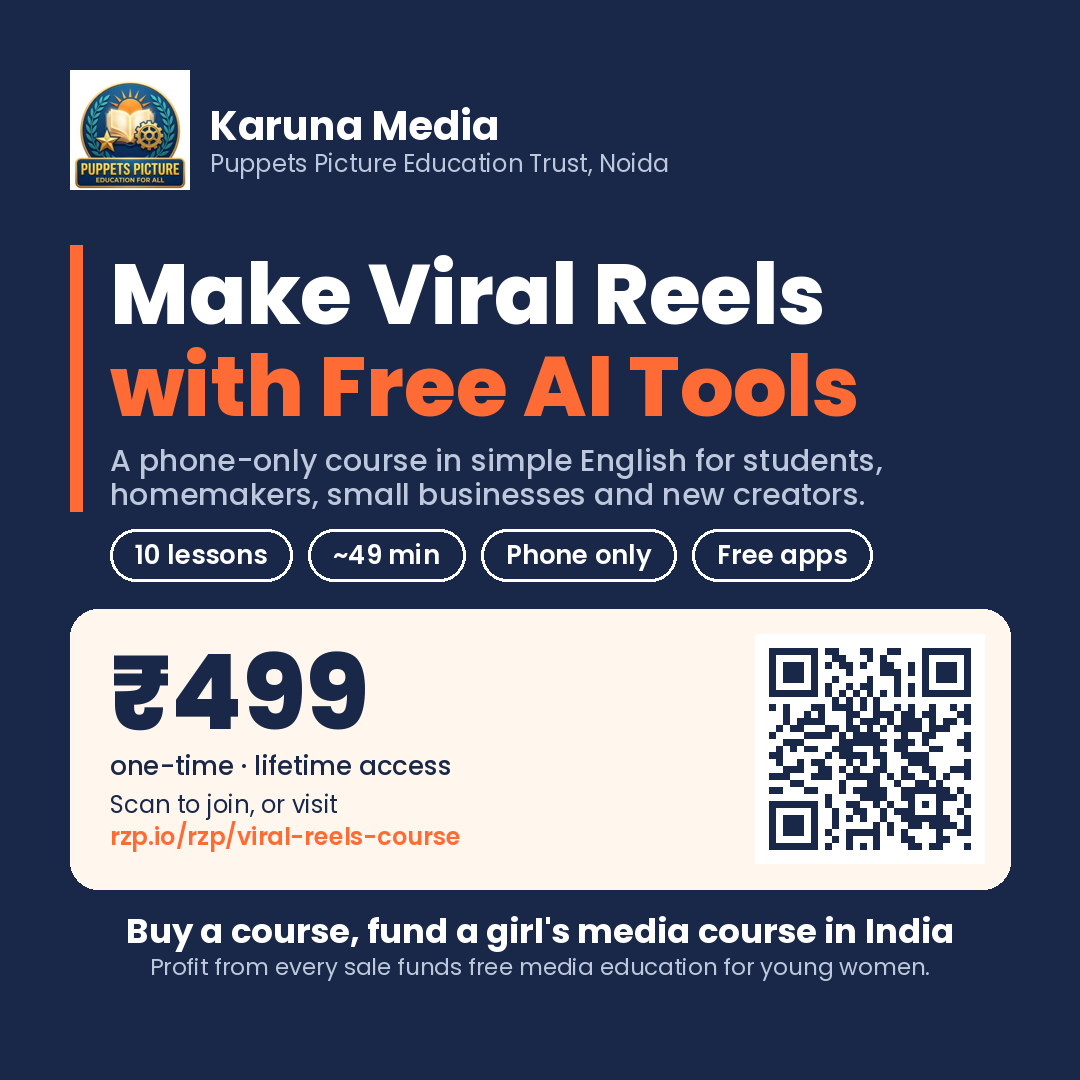
Online course · ₹499
Make viral Reels with just your phone and free AI tools
10 short lessons in simple English and Hinglish, with a 7-day refund. Profit from every sale funds a girl’s media course in Noida.
See the course